|
Genome Sequencing Analysis Core Resource -- March 31 2013
We have exciting news
to share with you this month. We launched our
Ion Proton sequencing service and new services
to facilitate your library preparation and
pooling. Also please look at important notes regarding
Sanger sequencing. As always, please email sequencing@duke.edu
with any questions.
|
Ion Proton Sequencer Is Here
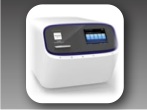
The Ion
Torrent Proton sequencer has now
been installed and is fully operational
for service. This new instrument
completes our Ion Torrent suite by
providing at least 10 times more
throughput than its predecessor, the Ion
Torrent PGM. Most of the same
libraries can be sequenced both on the
Ion PGM and Ion Proton in about the
same unbeaten 2-4 hours run time. A
seminar is planned for later this
spring.
|
|
|
Illumina Library Preparation Support
Starting April 8th, we will
offer several solutions
(fee-for-service and self-service
station) for helping clients preparing
and pooling their own Illumina
libraries (all services will require a
current sequencing order# and
scheduling). 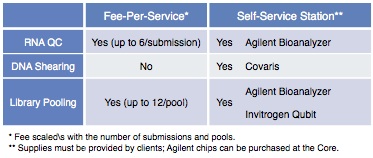 More
details will be available on the launch
date. More
details will be available on the launch
date.
|
 |
|
Sanger Sequencing Updates
Data
storage: Genesifter is not
designed for long-term data storage.
Data should be retrieved as soon as it
becomes available. We do not guarantee
long-term integrity of the data and we
also reserve the right to delete data
older than one month.
Sequencing Schedule: "Standard Sanger"
sequencing runs are scheduled Mon to Fri while "Fragment
Analysis" runs are on Thurs only. For
"Standard Sanger" sequencing, samples
should be submitted before 3PM to be
considered for a same-day run. For
"Fragment Analysis" the submission
deadline is on Wed at 5PM. While we
usually produce data withing 24 hours
of sample submissions, other factors
such as plate incompleteness may affect
the turnaround time. Nevertheless, we guarantee
samples to be on the intrument within 2
business days at the latest.
|
 |
|
Project Highlight
Dr. Charles Gersbach from
Biomedical Engeneering Department at
Duke University has engineered
transcription activator-like effector
nucleases with his group to correct the
reading frame and restore the
expression of a functional dystrophin
protein that is mutated in Duchenne
muscular dystrophy. He has been using
Agilent
Sureselect Exome capture and Illumina
HiSeq sequencing to verify that
there were no off-target DNA
modifications. He presented his work at
the RTP
Illumina User Group meeting on
Tuesday, March 12, 2013.
|
 |
 |